Noah’s Ark – Was it Really Big Enough?
Many Bible skeptics point out that there is no way the ark had enough room to hold all the animals and the necessary supplies to fulfill God's instructions to Noah. And on the surface, that seems to be a valid objection. However, if God told Noah how big to build the ark and how many animals to put on it, there should be no problem. But let's look "below the surface" and see if this makes sense.
How Big was the Ark?
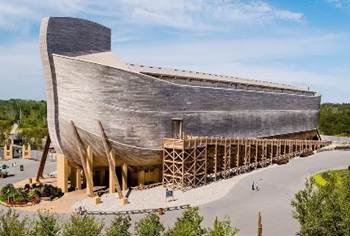
Image from the Ark Encounter exhibit
Here are the instructions God gave to Noah –
14 "Make for yourself an ark of gopher wood; you shall make the ark with rooms, and shall cover it inside and out with pitch. 15 "This is how you shall make it: the length of the ark three hundred cubits, its breadth fifty cubits, and its height thirty cubits. 16 "You shall make a window for the ark, and finish it to a cubit from the top; and set the door of the ark in the side of it; you shall make it with lower, second, and third decks. Gen. 6:14-16 (NASB)
Dimensions of Noah's Ark
300 cubits = 510' (FYI - a football field is 300' long)
50 cubits = 85'
30 cubits = 51'
Total cubic feet – 1.88 million cubic feet (after subtracting 15% for the hull's curvature)
To put this in perspective, you could put 450 semitrailers inside the ark! You could fit 120,000 sheep in that many semi-trailers. Watch this short video to see for yourself.
Note – a cubit was based on the distance from the elbow to the fingertips. Different cultures used different measurements ranging from 17.5" to 20.6". The above example uses one cubit = 20.4".
The image below gives a very misleading idea of the actual size of the ark. Sadly, this type of image appears in many different children's books. Take a detailed video tour of the ark here.
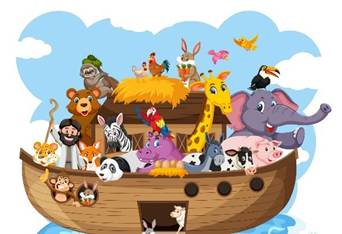
Typical rendering of Noah's ark – image from Vecteezy.com
Which Animals and How Many Were on the Ark?
First, God instructed Noah to bring two of every "kind" of animal and bird (both male and female) into the ark (Gen. 6:19-20).
Then God instructs Noah that his household should enter the ark (Gen. 7:1).
Next, God gives Noah more details about the animals that were to be on the ark, telling him to take seven pairs of every clean animal and seven pairs of birds (both male and female). Some believe the scriptures indicate seven total clean animals, rather than seven pairs of the clean animals (Gen. 7:2-3). The number of unclean animals did not change.
Genesis 7:14-16 gives us a recap of the animals that entered the ark – every kind of land-dwelling animal and every kind of bird.
Genesis 7:22 indicates only the land-dwelling animals that breathed through their nostrils would need to be on the ark, which would exclude insects. Also, all fish and other creatures that lived in the ocean were not on the ark.
What Does "after their kind" Mean?
The phrase "after their kind" or "after its kind" appears frequently in Genesis chapters 1, 6, and 7. The word "kind" comes from the Hebrew word min, which means – to portion out or sort, with the idea of separating from a larger group.Thus, in Genesis, min logically refers to biological subdivisions of two or more groups. While Bible scholars do not all agree with the meaning of this phrase, its use in Genesis always concerns populating, preserving, or repopulating the earth with plants and animals. Furthermore, the scriptures imply that plants and animals were created to reproduce only within their specific "kind" (Genesis 1:1-12, 21, 24-25).
Today, animals are classified into many different groups. The most widely used grouping system is the Linnaean classification system, developed by Carl Linnaeus over 200 years ago. Linnaeus was a medical doctor and believer in the God of the Bible. He believed the study of nature would reveal the Divine Oder of God's creation.
Linnaean Classification System
KINGDOM – PHYLUM – CLASS – ORDER – FAMILY – GENUS - SPECIES
The Linnaean system classifies animals from the broadest category (Kingdom) to the most specific category (Species).
This classification system was obviously not in place when the Bible was written; however, scientists have determined that the word "kind," as used in Genesis, most closely aligns with the "family" classification in the Linnaean system, although there are some exceptions.
The critical thing to remember here is that although God was going to destroy the earth and all flesh that was upon it, His plan was for it to be replenished with man, birds, and animals after the flood waters dried up (Gen. 8:13-17). The first thing He told Noah as they were departing the ark was that the animals were to breed abundantly on the earth (Gen. 8:17).
So, breeding compatibility was essential since repopulating the earth was the primary objection for determining which creatures were to be on the ark. Furthermore, God specifically stated that Noah should take both male and female of every animal and bird He specified – also a breeding necessity. Hence, there is no reason to believe that the specification of a "kind" of each creature did not also have reproduction implications.
It appears evident that all animals of a particular "kind" reproduce offspring of the same "kind." We know that each of these animals possessed the genetic information that would allow for many different species within their "kind." As you can see, this would significantly reduce the required number of animals needed on the ark to reproduce all the animals we see today.
Examples of "kinds"
House cats are of the same "kind" as lions, tigers, leopards, pumas, cheetahs, and all other common house cats. They are all in the Felidae family (aka felines). It would only require a male and a female of the cat "kind" to produce these many different species of cats.
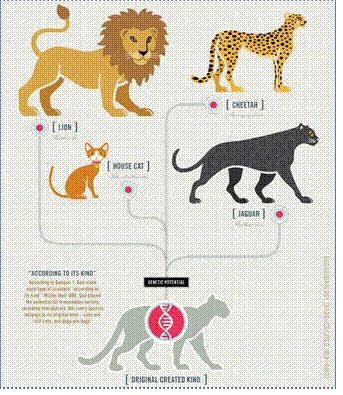
Image from answersingenesis.org
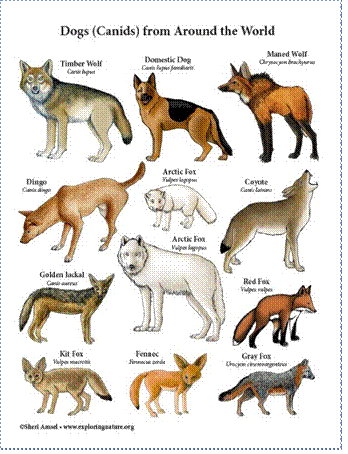
Image from exploringnature.org
Dogs are of the same "kind" as wolves, coyotes, dingoes, jackals, foxes, and all other domestic dogs. They are all in the Canidae family (aka canines).
While there are many different species of animals, they all remain within their original "kind," i.e., dogs always remain dogs, and cats always remain cats.
It should not be surprising that God's creatures have the genetic potential to diversify within their original "kind." God's plan was always to have the earth filled with humankind, birds, fish, and animals. As the environmental conditions around the earth greatly vary, so do the creatures that inhabit it. The process of "Natural Selection" played a major role in the diversification of these creatures to make them fit for their specific environment. (See below – "Natural Selection" is not "Evolution")
Watch this short video to help you understand about different species.
Also, watch this short video to help you understand created kinds.
So, How Many Animals Were on the Ark?
The short answer is that nobody knows precisely how many animals were on the ark. The evolutionists suggest large numbers to discredit the Bible by promoting the idea that it would be impossible to fit all the animals on the ark. However, they usually count all the species of animals and birds we see today as necessary passengers on the ark. But as demonstrated above, all the different species of animals did NOT have to be on the ark, just the different "kinds." Furthermore, many species we see today have only existed in the last several decades.
Many scientists have extensively researched this area and arrived at more feasible numbers. Below is a reasonable estimate based on all living animals and those known from fossil records.
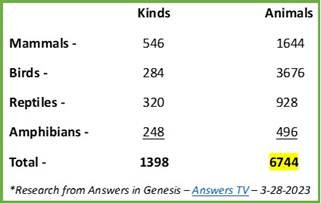
Biologists state that the average size for all the animals on the ark is about the size of a sheep. The living space a sheep needs is 11.12 cubic feet. So, if we multiply the number of animals (6744) by the average area required per animal (11.12 cu ft), we get 74,993 cu ft necessary for all the animals. Recall the size of the ark was 1.88 million cu ft! Also, keep in mind that the ark had three floors in it.
Also, consider that the larger animals, such as elephants, hippos, dinosaurs, etc., were most likely young and thus had not reached their full-grown size. Therefore, they would take up less space, eat less, and produce less waste.
As you can see from the numbers above, there would also be more than sufficient space for food and other supplies. So perhaps we should not be asking, "How could all the animals fit onto the ark?" but rather, "Why was the ark so big?"
"Natural Selection" is not "Evolution"!
Natural Selection is often confused with the theory of Evolution. Natural Selection is part of God's grand design to aid the adaptation of a population to better survive in specific environments.
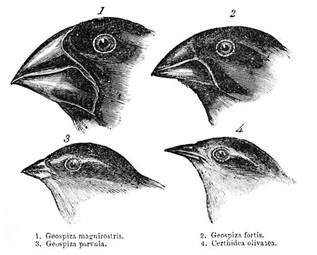
Image from Wikipedia
Perhaps one of the most famous examples of Natural Selection occurred on the Galápagos Islands in the 1830s, where Charles Darwin, an English naturalist, took notice of the finches on the various islands. Among other things, Darwin noted the different sizes and shapes of their beaks that occurred depending on which island they were on. His observations led him to conclude that these changes helped them better survive in their particular environment. While he was correct in this observation, his ultimate conclusion (that, given enough time, these finches would evolve into a completely different kind of animal) was incorrect. Furthermore, no one has ever observed that type of evolutionary change.
Evolution and Natural Selection are two very different processes. The Evolution of one kind of organism into a different kind of organism requires the gain of new genetic information, which has never been observed to occur. Watch Evolution Refuted in this short video.
The process of Natural Selection selects from the existing gene pool to allow for variations within the same kind. God has pre-programmed instructions within our DNA that can turn on or off specific genes to direct these changes depending on our environment. These changes can often occur within a very short time (a decade or less).
Conclusion
Hopefully, you are now better equipped to respond to those who say it was impossible to fit all the animals onto Noah's ark. I have found that it is often best to respond to that comment by asking your own questions. I suggest the following –
1. "Do you know how big the ark was?" (most people have no idea)
2. "Do you know how many animals were on the ark?" (Again, most people believe that the ark had to contain all the animals that are in existence today.)
Most people are looking for any reason not to believe the Bible. Equip yourself to lovingly provide the truth about God's word!
But sanctify Christ as Lord in your hearts, always being ready to make a defense to everyone who asks you to give an account for the hope that is in you, yet with gentleness and reverence; 1 Peter 3:15
Back to Apologetics
For More Information
Videos -
Websites – https://creation.com/ https://answersingenesis.org/ https://www.back2genesis.org/ https://www.icr.org/
References
1. How Could All the Animals Fit on the Ark?; Michael Belknap and Dr. Tim Chaffey; April 2, 2019
2. A Flood of Evidence; Ken Ham and Bodie Hodge; 2016
3. Taxonomy and Organism Classification; Regina BGailey; 2019
4. How Many Animals Were on Noah's Ark?; Ken Ham; 2022
5. The Kind-ness of God; A theological reflection of Min, "kind"; K.J. Turner; 2009
6. Variation, information and the created kind; Dr. Carl Wieland
7. Noah's Ark: A Feasibility Study; John Woodmorappe; 1996
8. Variety Within Created Kinds; Dr. Georgia Purdom; 2010
9. Strong's Dictionary
10. Theological Wordbook of the Old Testament
11. https://pressbooks.bccampus.ca/earthhistorylab/chapter/classific aon-of-animals-plants/; Carl Linnaeus
12. How Could Noah Fit the Animals on the Ark and Care for Them?; John Woodmorappe; 2013
13. How Many Animals Were on Noah's Ark?; https://www.biblestudy.org/biblepic/animals-on-noah-ark.html
14. The True Origin of the Species; Ken Ham; 2021
15. The Proper Place for Natural Selection; Dr. Georgia Purdom; 2016
16. Darwin, Evolution, & natural selection; Khan Academy
Images in order of appearance
Image of the Ark (above) is from the Ark Encounter Exhibit
Image of Noah's Ark with animals from https://www.vecteezy.com/
Image of cat "kind" from https://answersingenesis.org/
Image of dog "kind" from https://www.exploringnature.org
Image of Darwin’s finches – https://en.wikipedia.org/wiki/Darwin%27s_finches